

Industry & Technical
.webp?width=2742&height=3632&name=Usioaines%20FI%20May-16%20(5).webp)
.png?width=48&height=48&name=Mike%20updated%20photo%20(1).png)
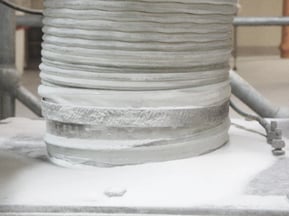 Maximizing product flow through the production line while minimizing waste and unplanned downtime is a key driver of operational efficiency for bulk powder processing plants.
When powder escapes from the process, it can create significant hygiene and safety concerns, while also increasing costs and reducing overall plant productivity.
Although many stages of the process are contained within purpose-designed equipment, the areas most vulnerable to product loss and resulting downtime are often the transition points between pieces of machinery.
.webp?width=228&height=302&name=Usioaines%20FI%20May-16%20(5).webp) Product loss has long been a challenge in powder processing plants, but today's increased focus on cost control and sustainability has made reducing waste more important than ever. Minimizing unnecessary product loss is essential not only for profitability, but also for meeting corporate social responsibility goals.
Product loss has long been a challenge in powder processing plants, but today's increased focus on cost control and sustainability has made reducing waste more important than ever. Minimizing unnecessary product loss is essential not only for profitability, but also for meeting corporate social responsibility goals.
Powder loss can occur anywhere product is transferred between stages of a process, but it is particularly common at points where machinery movement is involved, such as the inlet and outlet connections on sieves and sifters.
These transitions typically rely on some form of flexible connector. Whether referred to as a flex connector, sleeve, bellows, or boot, the connection must provide an effective seal and withstand ongoing operational demands to perform reliably.
Traditionally, dry bulk processing plants have used clamped flexible connector systems. However, even with diligent maintenance, these systems are often prone to powder leakage, leading to product loss and potential downtime.
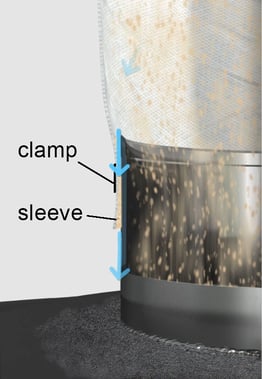 The core problem with most clamped connector systems is that they are fitted over the outside of the pipes and secured in place using external fasteners. This design inherently creates a pathway for powder to escape through the small gap between the pipe and the connector sleeve, regardless of how tightly it is clamped.
Even when product does not leak from the connection, powder can accumulate in the crevices around the outside of the pipe, creating potential contamination and hygiene concerns.
The presence of pressure further increases the likelihood of powder escaping from the connection and entering the surrounding plant environment. Any airborne dust released into the factory atmosphere must be taken seriously, as it can present a significant combustible dust and explosion hazard.
Equipment movement can also accelerate leakage and connector wear. Sharp edges on hose clamps frequently rub against the connector material, eventually causing holes, tears, and, in many cases, complete connector failure during operation.
The resulting downtime for cleaning, maintenance, and connector replacement can be substantial.
Beyond the safety risks and lost production time, ongoing product leakage represents pure waste. Over time, even relatively small losses can add up to a significant financial burden for powder processing operations.
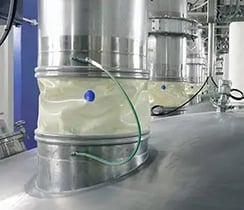 How to Keep Your Product Inside Your Process
The role of a flexible connector is to transfer product safely, reliably, and hygienically between pieces of equipment while preventing vibration or movement from being transmitted from one machine to another. In practice, however, many traditional clamped connector systems struggle to achieve this consistently, with leakage and premature failure being common, particularly in applications involving pressure or frequent movement.
This is why industries ranging from food and pharmaceuticals to minerals processing are increasingly adopting newer connector technologies designed to overcome the limitations of conventional systems.
The BFM® fitting system has proven to be a game-changer for powder processors. Its patented spigot-and-connector design is engineered to keep product securely contained within the process while simplifying maintenance and reducing the challenges typically associated with traditional flexible connectors.
One of the most significant advantages of the BFM® fitting system is its ability to eliminate product loss during product transfer.
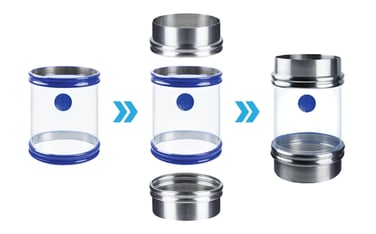 Unlike traditional alternatives that use hose clamps and gaskets, the BFM® fitting employs an easy snap-in, snap-out mechanism that fits the connector on the inside of the pipe, creating a secure and dust-tight seal.
The innovative design means the internal surfaces are smooth with no possibility of leakage or product build-up. Even with movement like that on sifters, the BFM® fitting connector stays securely in place. If the process operates with positive pneumatic pressure in the system, this simply pushes the connector outward into the spigot, improving the seal.
The durability of the materials and quality construction of the BFM® fitting system ensures they will outperform clamped connectors in every aspect and will reduce product loss and maximise productivity.
If you’re looking to minimise product loss and maximise operational efficiency, contact us for a no obligation chat!
.jpg?width=768&height=1024&name=Image%20(64).jpg)